Monday, 15 August 2022
Hum Onto Logic
Sunday, 14 August 2022
A monstrous suggestion: 'Black Orchid', Sapphire and Steel and more thoughts on the danger of nostalgia
![]() |
| 'I got two words for ya...' |
By chance today I found myself watching both the Peter Davison era Doctor Who serial 'Black Orchid' and the fifth and penultimate televised Sapphire & Steel 'Assignment'. This was a nice coincidence, as one of these stories is a disappointing murder mystery 'filler' episode largely disliked by fans, and the other is the 1982 Peter Davison Doctor Who serial 'Black Orchid'.
This is probably somewhat unfair on Assignment Five's writers, Don Houghton and Anthony Read (the only people to write for Sapphire & Steel on TV other than series creator P.J. Hammond), as at least they actually set out to write a script in which Sapphire and Steel were meant to appear from the get-go. A popular rumour among Who fans (based on comments supposedly made by Peter Davison) is that 'Black Orchid' scribe Terence Dudley pulled a spec script he'd written for a murder mystery series out of his bottom drawer and rewrote it with added Timelord to fill a gap in the show's Season 19 schedule.
That's a common enough practice in television, and even if it's true the rewriting done isn't insubstantial: a significant amount of the second episode of this two-parter is taken up with the Doctor veering away from the main plot to give the Chief Constable, Muir, the old get-a-load-of-the-inside-of-this-thing tour of the Tardis in an attempt to prove his time travelling bona fides (Muir, to his credit, rightly avers that the fact the Doctor has proved he is a time traveller does not necessarily disprove the murder charge he's facing, but events conspire to force everyone back to Cranleigh Hall at that point anyway); we get some nice scenes of Tegan and Nyssa learning about each other which also double as a chance to tick the 'see, it's still an educational show' box by teaching 80s kids about the Charleston and Adric...is also there, though mercifully not for long at this point, the next serial in the series, 'Earthshock', being notable for his demise and not much else. But I don't want to say much more about 'Black Orchid', at least right now - beyond pointing out that it is, to me, simply astonishing that none of the toy companies which have had the Who licence has ever produced a figure of Davison's Fifth Doctor in his Harlequin costume from this serial (if not indeed a box set featuring Tegan and Nyssa in their fancy dress outfits) - because, not for the first time, ITV's answer to the Doctor was the show treading truly weird ground - even in its filler episodes.
![]() |
| I mean come on Character Options, you'll make us pay for the same figure of Paul McGann with a different bag but you won't give us this? Sort it out. |
Calling Assignment Five a filler episode is perhaps a bit cheeky given that it constitutes the entire third season of Sapphire & Steel, a show which, even more than Doctor Who (proportionally speaking, allowing for the differing length in their periods of production and transmission) seems to have suffered from the perennial problem referred to by cult TV fans as 'being dicked around by the executives'. Assignments Five and Six were filmed together, but only Assignment Five was transmitted in summer of 1981, with Six being kept 'in the can' for future transmission. Unfortunately in the interim between Assignments ATV, the television company which produced Sapphire & Steel, was reorganised into Central Independent Television, whose executives threw the show out into the 1982 ITV schedule with little fanfare, some regional editions of TV Times apparently erroneously labelling it as a repeat.
But Assignment Five is filler in the sense that Houghton and Read were 'filling in' for Hammond, who said in a 1993 interview that he had been 'working too hard on the show' and 'needed to take time out for a rest'. The result is a serial that differs in some key respects from Hammond's vision: at one point, Sapphire is able to bestow the power of telepathy on a human character who aids them in the adventure, which it's hard to see Hammond writing; there is also a bit too much of an attempt made to explain the mechanics of what's going on, leading to a lot of guff about ley lines at one point, which might have been fashionable at the time (Sapphire & Steel dating from the same era as the 1979 Quatermass series, whose creator Nigel Kneale took out his frustration on hippies by writing a story in which they gather at stone circles and get vapourised en masse) but is way too much explanation for a show usually happy to leave things ambiguous.
![]() |
| This better not awaken anything in me |
What Houghton and Read do get right is the series' theme of the danger of nostalgia. This was explored most effectively in Assignment Two, 'The Railway Station', but it's a common theme in every episode: timebreaks occur in situations where something from the past is held onto too much in the present, allowing the various temporal and dimensional menaces which stalk the series to occur. The situation created by the industrialist Lord Mullrine in Assignment Five almost seems set up to invite time to break in and cause havoc: a perfect recreation of the night in 1930 when he founded his company with his late partner, Dr McDee - which also happened to be the night his partner died, and also the summer solstice (ley lines are involved somehow, remember). And, inevitably, things start going wrong: guests at the party start losing their temporal grip and then being killed off, one by one, and McDee himself returns, initially to much consternation though, as the anomaly establishes its grip, the guests later begin acting as if he has always been there - and, indeed, recreating their own actions of that night, revealing the dark secrets behind Mullrine's rise to prominence. And lurking behind it all is something much darker: an apocalypse that can only be prevented by McDee's death, and which is trying to make itself happen by preventing that death. You see, he's manipulating the genetic characteristics of a virus...
And here I am, almost forty years to the day after this series was cancelled, writing about what it tells us about the perils of nostalgia, in a time when the objects of nostalgia we look back to aren't just the 1930s Mullrine recreates with fiendish attention to detail in every room of his country mansion save one, but the then-high-tech computers and gadgetry of that one room, his office (which is also the room in which McDee was fiddling with a non-computerised virus on the night he died). Here I am writing about a story from the early 1980s about viral apocalypse, in a culture which isn't even yet recovered from the pandemic which shut down the world two years ago and is facing fresh attack by a scrappy young upstart pathogen. And, of course, the elephant in the room in all these posts digging into the past is my grief over the recent death of my mother.
I started rewatching the Tom Baker era of Doctor Who as a direct result of that grief. I needed to find something to do with my time other than just staring into space, crying and wondering what the Hell I was going to do with my life now, so one night, thinking about the memorable story of Tom Baker's 'knighthood', I decided to watch 'Robot' for the first time since...well, quite possibly the first time ever, to be honest, given that first Baker serial aired in 1974, three years before I made my own debut. And so, well...here we are.
In a way, 'Black Orchid' is an example of Doctor Who being nostalgic for itself. Much was made by series producer John Nathan Turner of the fact it was the first 'pure historical' (that is, a Who story in which the good Doc goes back in time and interacts only with humans from the past, with no Sontarans or uniboobed android mummies running around up to no good) since The Highlanders. Elizabeth Sandifer has written a lot on Tardis Eruditorum about how the JNT era is notable as one in which the show begins to engage with both its own fandom and the new technology of home video, both of which led to a renewed engagement with the past of the show (which, at the nadir of this era, led to a bunch of 'big returns' of characters remembered by the hardcore fandom but long-forgotten by most of the viewing public, which too often failed to provide their stories a dramatic hook other than the reappearance of these figures). So it's no surprise it doesn't quite pull it off, and gave Matthew Waterhouse food poisoning to boot. Trying to recapture the past is dangerous, as Sapphire & Steel tried to warn us.
All of which seems to ask the question: what the Hell do I think I'm playing with?
![]() |
| And do I have the right? |
Saturday, 13 August 2022
Lines written on seeing yet another public figure who regularly incites hatred against trans people defend yet another known sex offender working in yet another supposedly progressive profession
Must be one of those 'y' days,
those wonder why days,
those xxy days
those will my ass still be here in '25 days
because these days I'm navigating
through a hatescape, where papers
never-endingly assign blame the way
a tired nurse looked at me and assumed
I was the same as every other child she
hastily assigned male, so without fail
the Daily Mail will endlessly exhale a
gale of bile and vile insinuation.
And it gets, let me be frank, a little wearing.
And don't think I haven't noticed that you're staring.
Friday, 12 August 2022
Exercise
You told us
and we listened.
You told us
and we listened.
You told us
and we listened,
so why must you insist
on being so indignant?
We paid the people who we got
to make the survey a lot,
and were assured it would give us
the answers we want
and you filled it all out for us,
ticked the boxes that we gave you
(none of which related
to the pittance that we pay you);
you rated certain statements
on a scale of one to five
(you were not asked how you rated
I am thinking of ending my life):
you have been consulted.
We asked what you preferred
among the options that we gave you
and not all of you demurred:
the comfy and compliant and the hungry to advance,
we knew, would always give the answers we were keen to splash
on PowerPoints and glossy booklets given out each quarter
whose purpose
is to inform you
that you told us
and we listened,
so now you better shut it
and make do with what you’re given.
Hello! Isn't corporate-speak annoying? Especially when it comes in that faux-matey tone pioneered by Brewdog and Innocent Drinks where you try to pretend you're friends with the person buying your product instead of just blatantly asking them for money! Anyway this italicised bit of my posts is where I blatantly ask you for money. If you can pay me regularly, my Patrons get access to exclusive writing I don't post anywhere else online, including my regular AEW Dynamite and Rampage reviews! But I know (because I listen, you see) that making a regular commitment in these times of energy bills you need a wheelbarrow to pay is asking a lot so, if you'd prefer, I also have a ko-fi page where you can leave a tip if you particularly like something I've written. Like the poem above, for example! And if you can't afford to do either of these things and just enjoy reading my poems and posts that's cool too! I am just trying to be more professional at this monetising thing even though I hate it. Can you tell?
Monday, 8 August 2022
Some further thoughts on Sharron Davies and drag
One place you could see some strong women, as long as otherwise they conformed sufficiently to the male gaze to be considered presentable, was Gladiators, which went out on ITV on Saturday evenings as part of the government's Heteronormativity Enforcement Hour, during which you, the viewer, would be subjected to at least two and, on some occasions so rare there are nostalgic Facebook memes about them, all three of the Horny Trinity of Blind Date, Baywatch and Gladiators. See, this is how I know you can't 'turn' people queer. Because every night, sat in my grandma's house, I would watch this straight propaganda wishing Doctor Who was back on instead.
Actually I did rather like Gladiators, to the surprise of absolutely no-one reading this blog. But my memories of the show are tainted by my anorexia. You see, one of the things I would do during my starving and purging years, which overlapped my Gladiators-watching years but extended beyond them, was compare my weight to those of the female Gladiators. I never managed to get down to a point where I weighed less than, say, Jet or Nightshade, but I do distinctly remember the elation I felt one night when I realised I weighed less than Panther (though to be fair among my schoolmates Panther was regarded as one of the 'butch-er' woman Gladiators, which shows among other things that in their case at least the Heteronormativity Enforcement Hour was working according to plan). But that was one night, and I usually weighed more. And that meant I had to work harder. Eat less. Exercise more. Much more. Pop some laxatives tonight too, maybe (like most grandmas, mine was a feeder).
And, like - I can't be the only woman who grew up in Britain during those years, trans or cis, who had that experience, right? As I alluded to above, being a young woman during the nineties was like being under some kind of weird siege. Yes, according to the guys who were selling the Spice Girls to us this was the age of 'girl power' but it was also the heyday of lad mags and heroin chic and supermodels and in a weird way the constant media insistence that we were all having the best time of our lives during all of this just made it that much worse. There are a lot of women in middle age now who can remember an adolescence spent almost cutting our hands on our hipbones trying to look like one or other of the impossible idols we had shoved down our throats in those days, and I am willing to bet that for a substantial subset of those women the woman they were hurting themselves to try and resemble was one of the female Gladiators.
In fact, now we're all in the drawing room, let's name ourselves a culprit.
For some of those women, that woman was Sharron Davies.
And really, isn't it interesting that, these days, Sharron Davies goes after trans women, and drag queens? I can't be the only person who thinks there's something interesting in that, right? Because here's the thing. Sharron Davies is an Olympian, and no-one can take that away from her. But there are a lot of Olympians. And most do not stay in the public eye after their sporting prowess starts to falter. And they have to decide what to do with the rest of their lives. And Sharron Davies, at some point late in her swimming career, decided that she liked the fame and attention she was getting, and who wouldn't? And so, understandably, she looked for a way to keep those good times going now that younger, faster women were passing her ass in the pool, and she found that in Gladiators.
Or, to put it another way, to keep the money rolling in and her face in the paper, Sharron Davies collaborated with patriarchy in a way whose ill-effects are still felt in the bodies and minds of a generation of women. In an age when women were bombarded with impossible bodies digitally retouched and cosmetically enhanced to be male fantasies, she allowed herself to become one of those fantasies. One of the impossible women we half-killed ourselves trying to be.
And so it's particularly interesting to me that she slags off drag queens, because the thing about drag is that it is the ultimate in not complying with that system of targeted illusion, which may well be one reason for the popularity of contemporary drag among young women. Queens are pretty open about the fact that they achieve their, and I mean this in the best way, cartoonishly-exaggerated figures through prosthetic trickery. Where the picture of an Olympian idol like 'Amazon' (the name Davies chose on Gladiators, I kid you not people) seduces you with the false promise that if you train your body to conform well enough to patriarchy's gaze you, too, can look like that, drag includes you by saying that, yeah, sure, you can look like that but the only way is with trickery because it's all a trick. The whole thing's drag.
And I just, I don't know. I just think it's kind of interesting that Davies has a problem with that? Like, maybe that's kind of revealing? And like, maybe, just maybe it also explains why she really doesn't seem to like trans women? I'm just saying...
Hello, you! Thank you so much for reading this all the way down to the end and this paragraph appended to the essay in a doomed attempt to monetize our parasocial relationship! If you enjoyed sentences such as that last one, please consider becoming one of my Patrons or, if a regular commitment isn't feasible right now, buying me a coffee! There! You've considered it! Thank you!
'I've had enough of ghosts waging war on us!' Eric Idle's dead dad, boomer resentment, and Sapphire & Steel
I recently decided I should vary my televisual diet so I wasn't just watching old Tom Baker Doctor Who serials, so I started watching Sapphire & Steel, one of many attempts by ITV at doing their version of the BBC's perennially popular franchise, and one of the better ones. It's popular with the hauntological crowd: one of Mark Fisher's final essay collections opens with an essay about the show's final serial. I want to talk here about the second, or, in the show's terminology 'Assignment 2: The Railway Station'. But first, a diversion for another bit of Twitter talk.
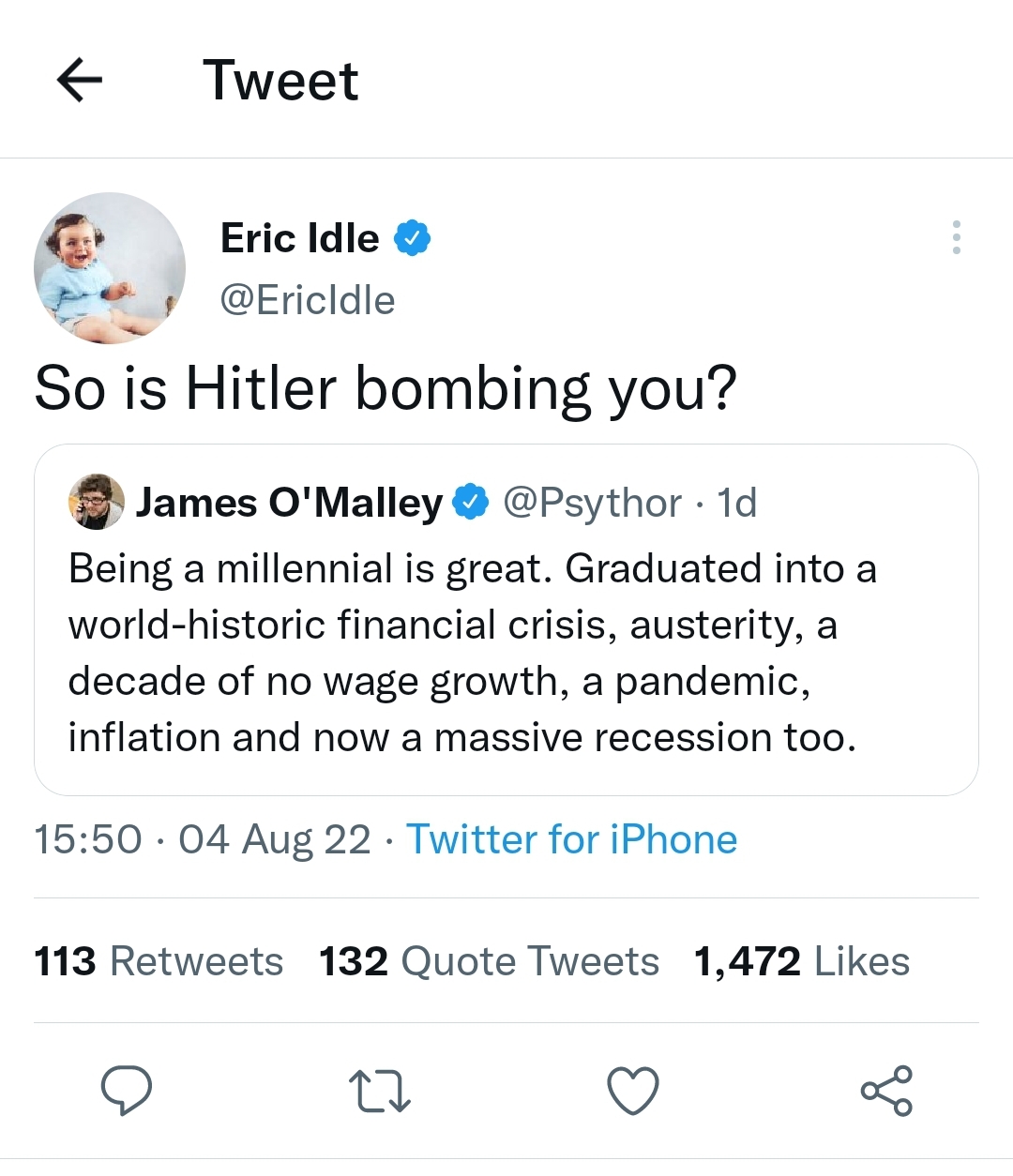
As last Thursday was a day ending in Y, a lot of people on Twitter were angry at millennials. One of those people is Eric Idle, and that Thursday Eric Idle decided to vent his anger at millennials facing the struggle of living at the end of humanity in a very familiar fashion. To a user complaining about a life beset by multiple crises, two pandemics etc, Idle (b.1943) decided to retort 'So is Hitler bombing you?'
It was pointed out to Idle by numerous people on Twitter that this was a bit rich, given that the period of his life during which Idle himself was being 'bombed by Hitler' coincides almost entirely with the period of his life when he was shitting himself and trying to learn that books are for reading, not eating. When it was further pointed out to Idle that as a member of the generation that came of age in the postwar years he was, historically speaking, extraordinarily lucky, doodlebugs or no doodlebugs, Idle retorted that we had no right to make light of his suffering, as his father had died during the war.Only he didn't, as Twitter user Jill Scott Heron pointed out:
Eric Idle's father Ernest served in the Royal Air Force during World War II, and fair play to him for doing so. But he died in a road accident while hitchhiking home for Christmas months after that war had ended.And that's what brings us back to the second Sapphire & Steel serial, because the antagonist for most of its eight episodes is an alliance between a disparate group of ghosts who have all suffered war-related deaths, and a malevolent cosmic force, referred to as 'the darkness', which is feeding on their resentment over the fact their deaths were all in some way unfair. The series gives us three examples: the main personified antagonist, Private Sam Pearce, a British Tommy who was shot and killed after the signing of the armistice; three shipbuilders who perished during sea trials of a submarine they were repairing; and a bomber pilot who perishes in a doomed plane one flight away from being demobbed. Ernest Idle could easily be added to that number: a man who died too late to be one of the war dead, but too early to be feted as a member of the Greatest Generation. One can blame neither his spirit nor his son for feeling resentment over this, over Ernest dying so close to the men with their names on memorials, but not in a way that would get his own name on one. Ernest's resentment, too, could feed the darkness (which might even take some pleasure in noting that 'Ernest's resentment' is univocalic).
'The Railway Station' is a fascinating example of the kind of programme you really couldn't make today, as the popular right-wing pseudo-truism has it: not just because the serial format of shows like Sapphire & Steel and classic Doctor Who has been all but abandoned by contemporary television (indeed, the only recent attempts I can think of are Torchwood: Children of Earth and, more recently, Flux, and while CoE still holds up, Flux sucked), but also because, in our poppy-obsessed times, can you see anyone at ITV greenlighting a show in which, for the majority of the run-time, the antagonist is personified as a noble British Tommy Atkins? A noble British Tommy who is, moreover, shown to be brimming with resentment and rage against the living, and who behaves towards the show's protagonists with open contempt and even a hint of sadism? It would be like Ncuti Gatwa's Doctor facing a villain based on Captain Tom. Which, incidentally, they should totally do.
![]() |
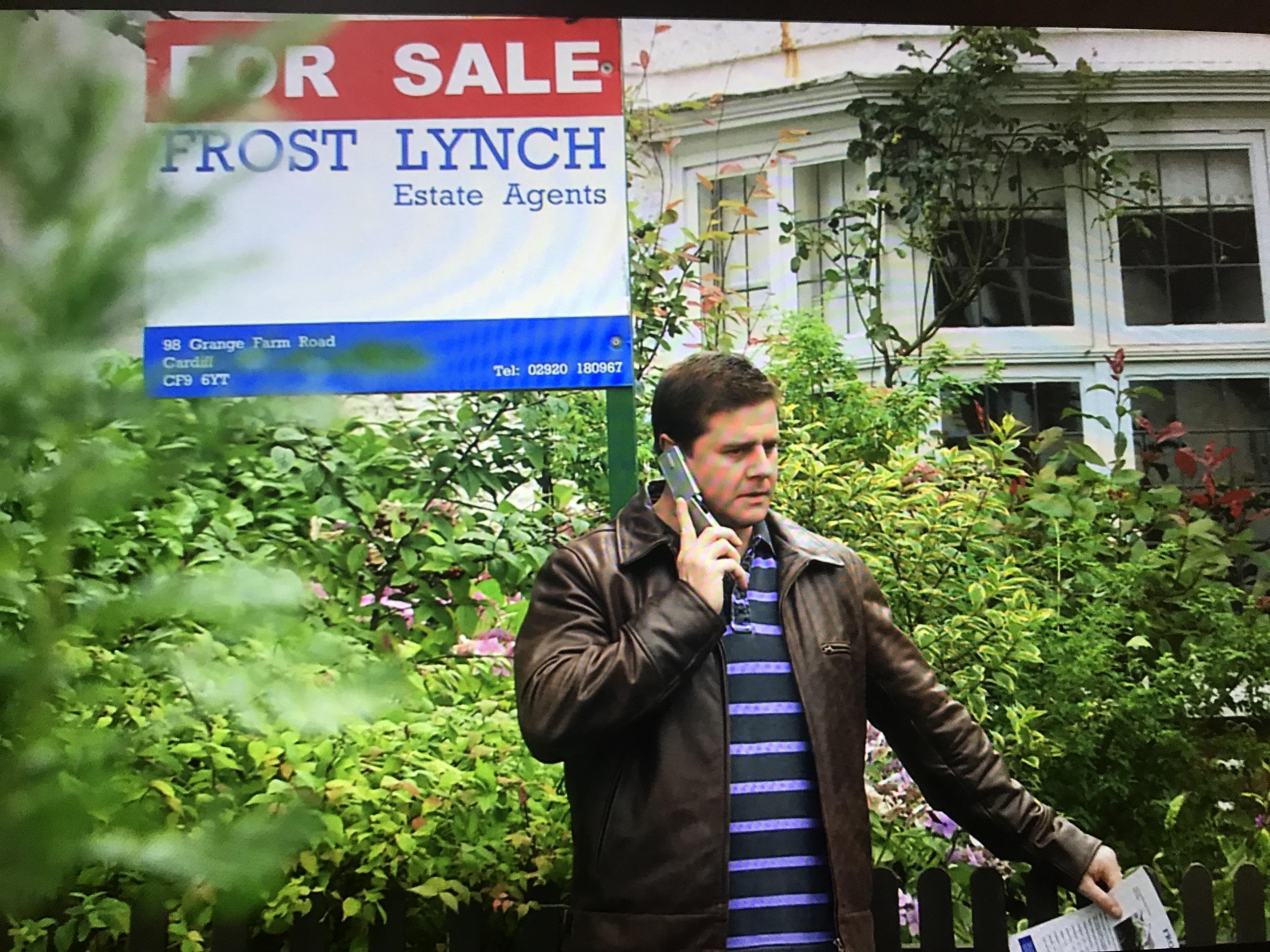
| Having mentioned Children of Earth, my favourite joke in it: the name of the estate agents |
What's interesting to me about watching this serial now, in 2022, a year in which we're all profoundly bored of boomer rants like Idle's, is how contemporary it feels in a way which, again, modern sci-fi media would probably rather not explore, not just because of the political themes but because modern sci-fi lacks Sapphire & Steel's sense of the abstract, of the metaphorical, the magical. If you compare Sapphire & Steel to something like Loki, it's clear how much more work has gone into making the world of Loki and the Time Variance Authority seem believable and realistic even though the central conceit behind the show - Magic Police who travel around fixing time - is essentially the same as the older show, though the degree to which Sapphire, Steel, and the various other Elements they find themselves working with are cops is left ambiguous. In Loki, we get an educational video explaining how time travel, multiverses and the TVA work, delivered by Miss Minutes in a knowing nod to Mr DNA in Jurassic Park. In Sapphire & Steel, we get an introductory voiceover explaining that 'All irregularities will be handled by the forces controlling each dimension', cautioning against the use of 'transuranic heavy elements...where there is life', and finally informing us that the titular elements 'have been assigned' and are then left to catch-as-catch-can as far as whatever else is going on - putting us in almost the same position as the human characters who encounter Sapphire and Steel, though slightly better off than them because as audience we are privy to their telepathic conversations - something which 'The Railway Station' handles very deftly, as it happens, with these conversations between the duo gradually leading us to realise dark things are in store for that story's human companion, the psychic investigator (in the Guy Lyon Playfair rather than Patricia Arquette in Medium sense), George Tully.
But this dreamlike, metaphorical quality is precisely what allows Sapphire & Steel to so effectively explore an idea like the role of resentment in, to borrow a line from that suspect pair of Johns Savage and Lydon, England's dreaming. All three cases of neglected wartime death that we encounter are located in familiar contexts, all slightly altered in some way. When we first encounter Sam Pearce, much is made of the send-off he and his fellow troops were given at the railway station: cheering crowds, a band playing 'Pack Up Your Troubles', all very much the lost innocence of Larkin's MCMXIV. But this leads us down a false trail as a viewer, trying to fill in bits of Sam's story before we know it: crucially, before we know the cruel, ironic detail that he was shot eleven minutes after the signing of the Armistice - the eleventh minute of the eleventh hour of the eleventh day of the eleventh month, meaning that his death, though orthogonal to Britain's official commemorations of its war dead, will never be counted amongst them. The three shipbuilders who are killed in the unseaworthy submarine in 1938 are the Rosie the Riveters of wartime propaganda, but are shown, in a seance conducted by Steel (using Sapphire as his medium), to be angry and bitter about their deaths, which they see as a result of what we would now call corporate manslaughter rather than as acts of heroic sacrifice (working class resentment of authority was something which would have been very much in the air at the time this serial went out: indeed, early episodes of it were shown twice due to an unplanned break imposed by a television strike during its original airing); and we see the bomber pilot fruitlessly touring mess halls and being turned down because, as the last of his squad, he's regarded as a Jonah. All five (there are three shipbuilders) are denied a place in the grand national pageant into which our myths about the 'Blitz spirit' recast the wars of the twentieth century: all are excluded in some way from the lost innocence, the barrack room bonhomie, the esprit de corps.
It's easy to see who these people would be now: people like Belly Mujinga, dead of covid after being spat on by a petulant racist during the days when we were all clapping for the NHS; the delivery drivers we leave out of our nostalgic conversations about being on furlough; people like the Afghan translators we left behind in that country to be murdered by the Taliban while making sure we got our dogs out. Like them, all the ghosts in 'The Railway Station' have suffered deaths which we leave out of our national narrative because those deaths make it more complicated: and their resentment is used by the darkness to sustain itself as it falsely promises them a return to life and revenge on the living.
![]() |
| Our hero, trapped in barbed wire, is mocked by a sadistic British Tommy. |
Of course, the darkness which controls our nation's dreaming now motivates a different source of resentment: not the resentment of those left out but resentment of those people themselves, by those who made out okay. You can see it in the apoplectic anger of our establishment media when people suggest we acknowledge the crimes of our Empire. You can see it in the weird neuroses people have about acknowledging the obvious fact that coffee shop baristas are working class. You can see it in the property developers who mocked the people who died in the Grenfell Tower fire because they felt those (largely black and brown) people were getting too much public sympathy. The best examination of these resentments remains the late David Graeber's 'The Center Blows Itself Up: Care and Spite in the Brexit Election' which, among other things, gives a historically on point explanation for Idle's hissy fit (and the fulminations of those like him):
'One could even go further: the most passionate opposition to Corbynism came from men and women in their forties, fifties, and sixties. They represented the last generation in which any significant number of young radicals even had the option of selling out, in the sense of becoming secure property-owning bastions of the status quo. Not only had that door closed behind them; they were the ones largely responsible for having closed it. They were, for instance, products of what was once the finest free higher education system in the world—having attended schools like Oxford and Cambridge plush with generous state-provided stipends—who had decided their own children and grandchildren would be better off attending university while moonlighting as baristas or sex workers, then starting their professional lives weighted by tens of thousands of pounds in student debt. If the Corbynistas were right, and none of this had really been necessary, were these politicians not guilty of historic crimes? It’s hard to understand the bizarre obsession with the idea that left Labour youth groups like Momentum—about the most mild-mannered batch of revolutionaries one could imagine—would somehow end up marching them all off to the gulag, without the possibility that in the back of their minds, many secretly suspected that show trials might not be entirely inappropriate.'
These days, the resentment to which our legacy media gives most voice is the resentment of the world-historically fortunate for those who remind them just how very fortunate they are, of which Idle's ire at millennials is a perfect example. Let's end, then, with a note of caution for these fortunate resenters. You see, as pointed out above, the alliance between the resentful ghosts and the darkness does not hold for the entirety of 'The Railway Station'. Late in the story, Steel confronts Pearce and gets his revenge for the latter laughing at him strung up in barbed wire by pointing out he is being used by the darkness. Pearce and his fellow spooks will never return to life and get revenge on the living: instead, they are condemned to forever play out their charade, mustering at the railway station so the darkness can feed off their resentment. Doomed to play out the same old grudges forever, all to nourish an inhuman, Lovecraftian entity which couldn't give a shit about their bad luck beyond the fact their anger makes them succulent.
Perhaps Eric Idle is happy to be food for the Old Ones. Me, I've always set my sights higher.
Sunday, 7 August 2022
AEW Battle of the Belts III review now up!
So today, with my review of AEW Battle of the Belts III, I complete my goal of having written something every day this week, including the weekend! My AEW reviews are a special thing I do for Patrons - you can find the new one (which to be honest is mainly about how much I love watching Jamie Hayter beat people up) and all my previous reviews on my Patreon. Highlights include: the aforementioned Jamie Hayter simping, a firm commitment to taking every opportunity to slag off Jay Lethal, a section where I talk about watching a match between Mark Haskins and Gabriel Kidd while on edibles, and my ongoing efforts to come up with parody titles for Wednesday's Quake at the Lake event, which, for my money, reaches its apotheosis in this one. Check it out!